Like many legacy Metro systems, the NYC subway is doing its best to improve accessibility in its system. While I can understand that this will be a long, tedious process, their promise of making 95% of the system accessible by 2055 is still laughably slow. But given the reality that this is the speed that the MTA is going to be making the system accessible, it means that it is vitally important that they prioritize which stations will be made accessible. In this metric I think the MTA is doing an alright job, but I still think that they could be doing better.
My Overall Strategy
The way I would strategize making the system ADA compliant is by first by prioritizing by connections, then termini, then by prioritizing by ridership. The reasoning behind this strategy is as follows.
Connections are vitally important to using the system effectively, so ensuring that all connections can be made is extremely important. This would apply to four different types of stations:
First are stations where two different lines have a connection. A simple example of this is New Utrecht Ave/62 St on the N/D (which is already accessible!). Having these stations be accessible allow much better trips to be made. Imagine a journey from 9 Ave on the D to 20 Ave on the N. If New Utrecht Ave/62 St wasn’t accessible (and the other stations were), a passenger who requires accessibility changes would have to backtrack to 36 st, then take the far less direct N train to 20 Ave, which would make the system far worse.
Second are express stations. A simple example of this would be 72 St on the 1/2/3 (which is also already accessible!). Having these station be accessible allows riders to better utilize the local/express model that NYC is famous for. In theory, it would be possible for someone to transfer from the 1 to the 2/3 without leaving the platform, but that only works in one direction. There are a lot of reasons why a local train may skip a local stop (anyone who has taken the 1 during rush hour has certainly seen them all), so imagine if a journey was being made from 28 St to 66 St on the 1, but due to standard 1 shenanigans, the train expresses from 42 st to 72 st. The rider didn’t hear the announcements due to the god awful announcement speakers on the R62s. If 72 st wasn’t accessible, this rider would be screwed. But since it is, they have no issue switching platforms and catching a downtown train.
Third are stations with external connections. The most obvious of these are bus connections. I know that pretty much every station has at least some type of bus connections, but not all busses are equal. The most obvious type of station is one that has a separate rail connection. The most glaring miss here has to be Marble Hill, which has 0 elevators despite having both a subway and a Metro North Station. But this should also apply to LIRR stations and PATH stations too. Now for busses, its crucial to emphasize bus ‘hubs’ first. In Queens, due to the huge transit deserts that exist, there are major bus routes that feed into subway stations, like Flushing – Main St. Stations like these should be prioritized to get accessibility upgrades to ensure that the busses can serve the needs for accessible riders. Lastly, we should also be prioritizing stations that connect to the SBS’s seen throughout the system. Most egregious here are the lack of accessible stations along 125 st for the M60 SBS for the 1 2 or 3. You would think that an elevator would help airport bound passengers with big bags but the MTA seemed to miss that (although 125 St on the 2/3 is planned to get elevators in the 25-29 capitol plan)
Finally are stations with partial accessible connections. For some reason, there are dozens of stations that are partially accessible, meaning that at least one platform can be reached but not all of them. Some of these are simply a WIP, and will get the other elevators soon, but some of them aren’t which is, to be frank, ridiculous. The most rediculous to me has to be 168 st, which has elevators from street level to the mezzanine, mezzanine to the A/C platforms, AND elevators from the mezzanine to a passageway above the 1 platform, but then somehow drops the ball and has like a half flight of stairs from that passageway to the final platform. I would think plenty of A/C train riders may want to continue their journey north on the 1 from there, but unfortunately the can’t if they have accessibility needs, and should have transferred over 100 streets ago at Columbus circle… This can also be seen in places like Time Sq, which is completly step free from the main complex to the A/C/E platforms but that step free passageway is too steep to be ADA accessible, South Ferry, which means 1 riders can’t continue their trip to Brooklyn on the R/W, and too many more! I know these are usually left this way because the difficulty in making the whole station accessible is much harder but these missed connections are usually some of the most important in the whole system (looking at you, Union Sq) and makes the system more confusing for everyone.
Once all of the connections have been made accessible, the next thing that needs to be done are the termini of the lines. There should always be some sort of purpose to continue riding a train, but if our termini aren’t accessible then that wouldn’t be true for some riders. If their journey is beyond the termini, they should be able to make it as far as they can on the train. For non standard termini (like Bowling Green on the 4/5), this is even more crucial. Many riders may not realize they are on a train that terminates there, so it is important that they have options to continue their journey, which may require them to change platforms. The least important of these are local termini where the express continues going beyond (like Euclid Ave on the A/C) but even here these stations are usually used enough to justify accessibility upgrades regardless. The MTA has seemed to realize this luckily, as most of the normal termini have been made accessible, but there are still some missing (Brighton Beach, New Lots Ave, 242 St). As for the non-standard termini, there is still a long way to go (Rector St, Delancy St – Essex St, Neried Ave).
Lastly, once all of these stations are made, then its just about filling in the blanks. I would prioritize two things here: ridership, and “gaps”. Ridership is obvious – stations that receive more riders should get upgrades first. The potential of making, for example, East Broadway (F) accessible rather than Beach – 105 St (A,S), is pretty obvious. The next would be what I’m calling “gaps” in the system. Essentially there shouldn’t be a huge block of stations without an accessible one. For example, let’s look at the A train from Euclid Ave to Lefferts Blvd. If someone with accessibility needs needed to go somewhere between these two stations, they would have to go to one of them and take a bus the rest of the way. If that was, say, Rockaway Blvd, that would be a relatively long bus for something that is along the path they were already on. If we ensure that, say, there will be “gaps” no longer than 3 stations, then either Rockaway Blvd or 88 St would be prioritized to become accessible, which would make a potential “last mile bus” be much shorter. (to be fair, Rockaway Blvd should be made accessible regardless, so riders can transfer from the Rockaways branch of the A to the Lefferts branch)
Now that a strategy has been established for making stations, lets look at how the MTA is choosing stations, by looking at the current list of stations to be made accessible, as well as the stations set to be made accessible in the 25-29 Capitol Plan.
Current Stations Being Made Accessible
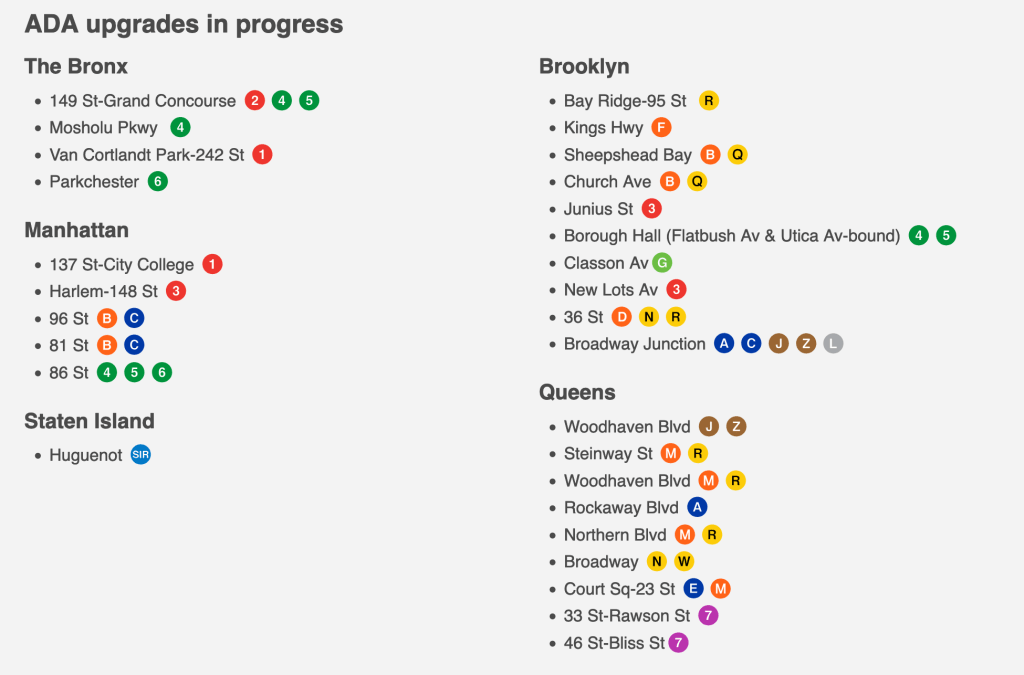
This is the list of stations, directly from the MTA website, of stations being made accessible.
Lets start with the good: there are a lot of great connections being made accessible here. Borough Hall being made fully accessible is huge. Broadway Junction is another great choice here. Wrapping up Court Sq is also super important. There are also multiple termini here getting patched. Most obvious are 242 St and Bay Ridge, however its easy to miss 137 St – City College (1 trains use this as a terminus during rush hour) and Parkchester (6 local trains will use this as a terminus where <6> trains are running).
Next the “eh”: I probably wouldn’t prioritize these stations but I’m also not going to be annoyed by these.. Headlining this list is Woodhaven Blvd on the J. It has an important connection with the Q52/53, as well as other busses going down that corridor, so its definitely needed, however I’m surprised its happening this soon (although without this one, there would be no accessible stations between Broadway Jct and Jamaica, so on second thought its probably better than I’m giving it credit for). Another one would be 81 St on the B/C. There’s definitely a gap here, and given that 81 St is an important leisure destination, I don’t hate it.
Lastly are the misses on this list. 33 st – Rawson St will take my top spot for this. It is already relatively close to multiple other accessible stations, and I don’t see any new connections that it provides that we don’t already have. Another is Mosholu Pkwy. Why isn’t this Woodlawn? As a reminder I’m not mad that we are getting new accessible stations, any accessible stations is a good one, but in a world where accessibility project go this slowly, I have to be a least a little critical on the order of these projects. Now, hopefully the MTA has avoided some picks like this for the 25-29 capitol plan.
25-29 Capitol Plan Upgrades
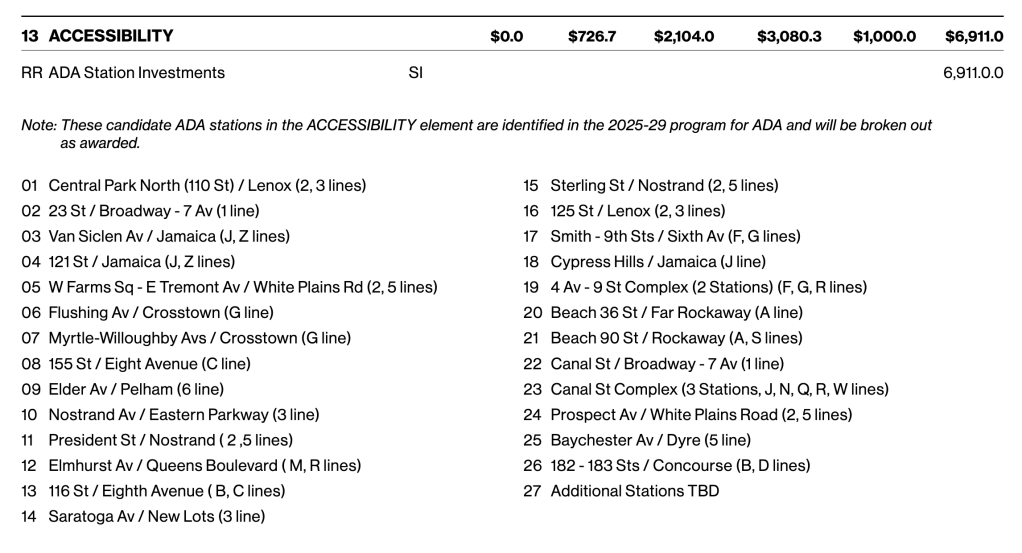
To be honest I’m pretty dissapointed with what’s here. I feel that the MTA has decided that they have done a “good enough” job in getting the bare bones connections on the system complete and are now just trying to get as many stations accessible as possible. Again, any accessible station is a good one, but I could not justify many of these stations to be done as soon as they are. How is 155 st on the C getting upgraded before 145 st on the A/B/C/D? Why is Cypress Hills, one of the 15 least used stations on the whole network, getting elevators this soon? Same with Beach 90 st!
Look, this plan isn’t all bad, there is some good stuff in here (4 Av – 9 St and the Canal St Complex are definitely the headliners) but the lack of will to finish the stations that are already partially accessible baffles me. If I had to make a list of the 26 most deserving stations for accessibility upgrades, it would look very little like this.
Conclusion
Accessibility upgrades are extremely important. Even for those of us who don’t need them, things like elevators, better signage, and step free access are still incredibly useful to us (ever travel around with bags?!). But even if that weren’t the case, a fully accessible system is a must have, and every elevator installed is a step in the right direction. However, that doesn’t mean that every step brings you the same amount closer. Some steps (like elevators for the 4/5/6 at Union Sq) are practically leaps forward, making trips better for so many people. Other (like Cypress Hills) are like an inch forward on your tippy toes. While they are important to getting us to the finish line, when we are this far away from that finish line, we should maybe look to taking bigger steps. I hope the MTA looks to making bigger steps in the nearer future, and saving those smaller steps for when we are closer to the finish.
 David Rosenstein's Blog
Leave a comment