- The Problem
- An Overview of the Two Projects
- Eastern Pkwy Line (2/3/4/5) Deinterlining
- F and M Swap
- Conclusion
There has been two huge announcements that were noticed yesterday that I have been dying to talk about! This is going to be a lot of yapping from me so I want to explain a couple things for people who are not big into transit circles so this article makes sense. If you are already an expert, use the table of contents above to skip around!
The Problem
Before we talk about anything, what exactly is going on here? Well to start, the MTA Subway makes heavy use of “interlining”. Interlining is the practice of running multiple different services on the same track. This is typically seen on most Metro services as branches. A simple example of this is the MBTA Red Line in Boston
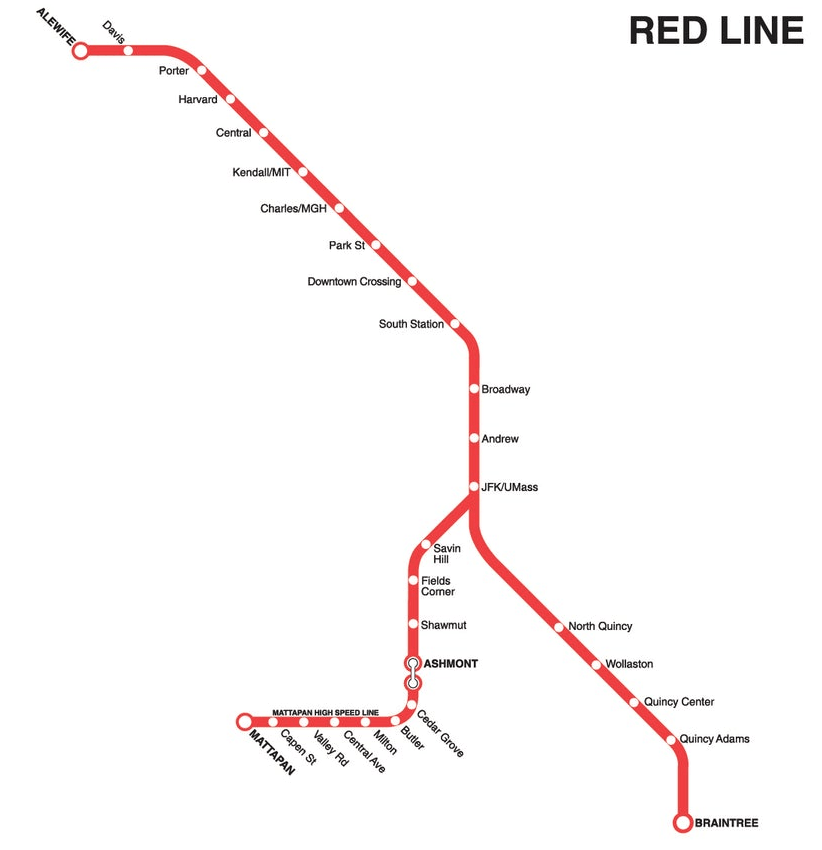
The Boston Red Line has two interlined services here: one from Alewife to Ashmont and another from Alewife to Braintree (the Matapan Shuttle is disconnected from the rest of the Red Line so you can ignore it).
What makes the MTA different is that the MTA will have branches both split off and recombine with other services throughout the whole system. This is most easily seen in the A division (or the numbered lines). The 2 and 5 trains run combined (or they are interlined) on White Plains Rd Line. Then after Grand Concourse – 149 St, the 5 train will split from the two train and combine with the 4 train down Lexington Ave, while the 2 train will cross into Manhattan, and combine with the 3 train down Lenox Ave. This “split and recombine” system is seen across the whole system from Dekalb Ave (where N trains split from Q trains to run with D trains, and B trains split from D trains to run with Q trains), to the Queens Blvd Line (F trains will split from E trains, go into Manhattan, then recombine with M trains), and most confusingly within the Broadway Line (N trains switch from the express track to the local track at 34 st – Herald Sq, splitting from Q trains and running with R and W trains).
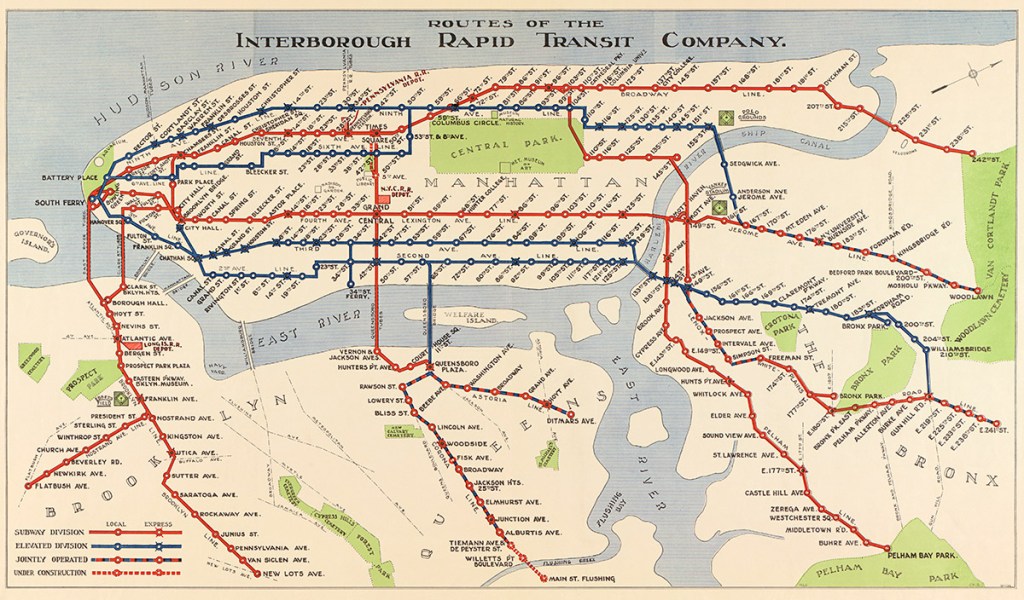
Interlining like this has pros and cons. The main pro is the potential for “one seat rides”. Passengers like the concept of being able to take one train to their final destination. However these one seat rides come at a major cost: the number of trains that are able to be run. It is operationally very difficult to handle all these trains merging and splitting at all these junctions. And while moving to modern signalling technologies like CBCT will help increase the number of trains that can run through these junctions, it still doesn’t compare to the capacity that gets lost by this merging. Having one or two merges/splits on a line is feasible, but any more than that is really pushing it and will seriously cut into both capacity and reliability (have you ever wondered why the 7 runs so much better than the Queens Blvd Line E/F/M/R? This is why!). When the subway was built, the amount of capacity needed was low enough that this wasn’t a major concern, and there were tons of one seat rides. But NYC’s population has more than doubled since the subway first opened, and now that NYC’s population is growing again after a COVID induced decline, the need for capacity and reliability has outgrown the convenience of these one seat rides.
This all explains why many transit advocates are calling for the MTA to further deinterline its system. And it seems that two projects have been created to do just that! Lets take a look at them
An Overview of the Two Projects
The first project is a partial deinterline of the A division (numbered line) trains in Brooklyn. The MTA is looking to build a new junction on the Eastern Pkwy Line. This wasn’t really announced in any way, but rather was discovered in an updated version of the 2025-2029 Capitol Improvement Plan. The Plan was recently passed by the MTA and has started securing funding from NY State and Federal Governments. When it was passed, the final version was released which had an interesting new section on the signal improvement page. (thanks to StreetsBlog for pointing this out!)
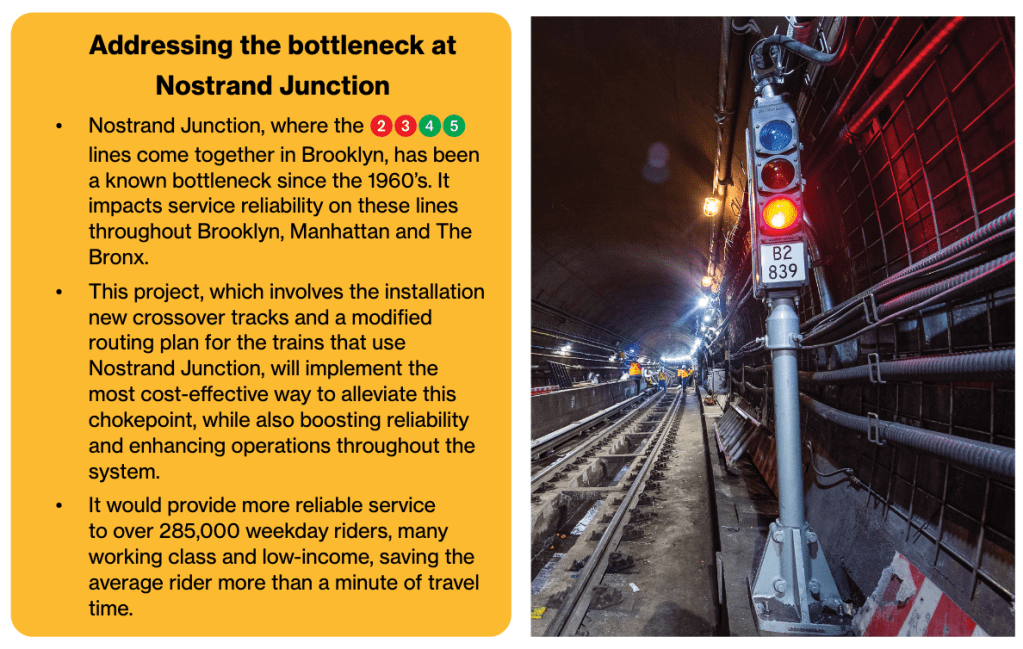
This junction will partially deinterline the 2/3/4/5 in Brooklyn, eliminating a key merge point after Franklin Ave. But before we discuss more of that, there was more deinterline on the same day! The F and M are going to which tunnels they use in Queens. This means that the M train will go through the 63rd St tunnel, stopping at 21 St – Queensbridge, Roosevelt Island, Lexington Ave – 63 St, and 57 St. Meanwhile, the F will go through the 53 St tunnel, stopping at Court Sq, Lexington Ave – 53 St, and 5th Ave – 53 St. This was found out by the Roosevelt Islander reaching out to the MTA directly (credit to them as well for the image below!)

Both of these were posted on the same day, making for a crazy day for deinterlining supporters. But now that we have calmed down, lets do a deeper analysis of both plans, understand what they will fix, and how they could improve the system. We will also look at some of the downsides of these plans as well, as there are legitimate cons that deserve to be looked at, even if I am definitely in favor of these plans.
Eastern Pkwy Line (2/3/4/5) Deinterlining
The actual 25-29 Capital Plan only has that little blurb describing what is happening to the Eastern Pkwy line, and a plan that “involves the installation of new crossover tracks and a modified routing plan for the trains” is painfully vague. Luckily, this seems to be directly based on the plan we saw in the 20 years needs assessment that was published in 2024, so I am going to assume that the plan is based on that.
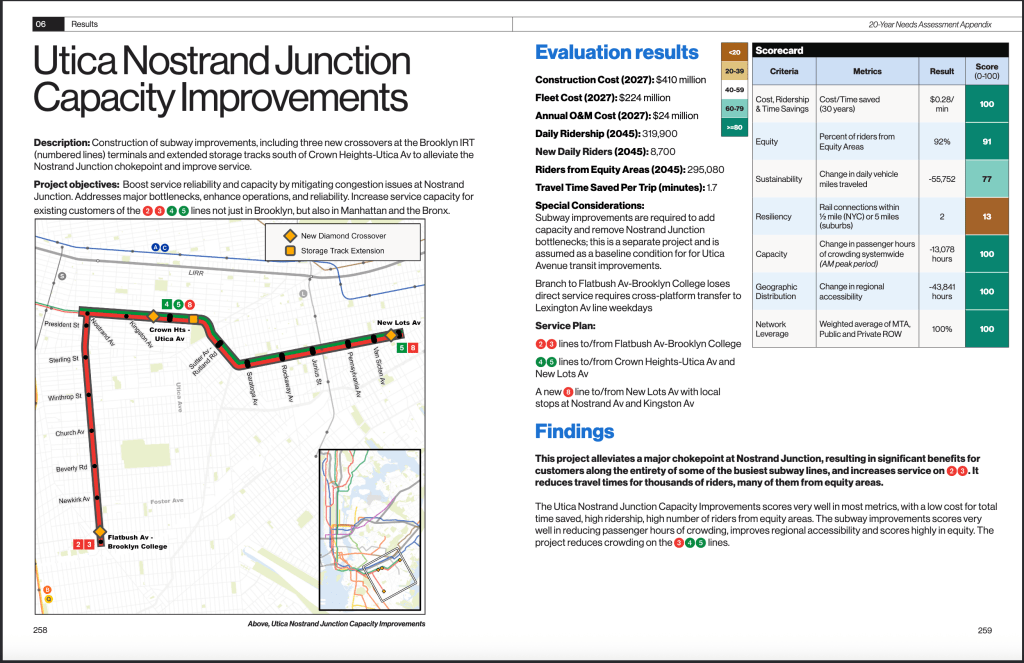
Let’s explain the deinterline here. First let’s look at the current track layout. All maps are either taken directly from, or adapted from vansnookenragen’s excellent track map.
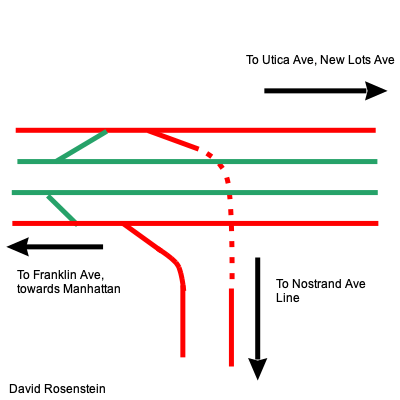
As you can see, the 5 line (which runs in the middle track up to Franklin Ave) has to cross onto the local track before it is able to go onto the Nostrand Ave Line with the 2. This crossover eats a ton into capacity onto the 5, 2, and 3 lines, making all three lines less reliable. Now the simplest suggestion that we have seen to solve this is to connect the express track to the local track AFTER the junction, so 4 or 5 trains could just hop onto the local track without interfering with Nostrand Line bound trains. Then you could divert the 3 train with the 2 and that solves all merging conflicts. However, that is pretty much impossible. That’s because I heavily simplified the junction in that diagram, and it really looks like this:
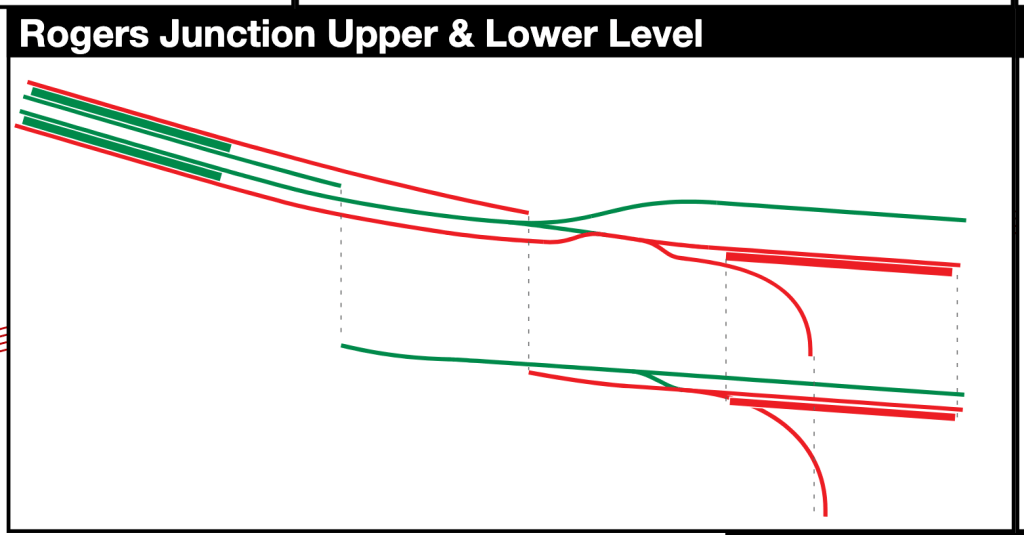
The Eastern Parkway line after Franklin Ave has a stacked design, similar to the Central Park West line in Manhattan, which makes modifying the junction in a way where express trains can switch onto the local a total nightmare that would require the complete rebuilding of the junction, and probably a multi-year long shutdown. The MTA doesn’t seem to want that (which is good) so they instead took a different approach.
They are adding new junctions near the Utica Ave station, so that trains on the express tracks there (which are much more accessible to the locals than near the Nostrand Ave Junction) will be able to cross over onto the local right before they enter the station. The provisions for these crossovers already exist, meaning that this construction work will be a lot less disruptive than a junction near Nostrand Ave (more on this later).

This raises a problem though: how will the local stations between Franklin Ave and Utica Ave be served, if the 3 train is going down Nostrand Ave? The solution: a new service, the 8 train. The 8 train will essentially be the 3 train in Brooklyn and a 2 train in the Bronx, running from Wakefield to New Lots, on White Plains Local, 7th Ave Express, and Eastern Pkwy Local. From there, the 5 train will use the new cross over to go from the express track onto the local and run with the 8 train to New Lots, and the 4 will continue to terminate at Utica. This will make a new merging conflict at Utica Ave, however there will be way fewer 7th Ave trains to deal with, since most of them are running down Nostrand, so this will be far easier to manage, and eat less into capacity. This service pattern will be easy to adapt for weekend service – simply run the 3 and 8 trains but not the 2 train (with 5 trains still terminating at Bowling Green, and 4 trains going to Utica). Late night service will likely run the 3 local from Harlem to Flatbush, and the 8 will run local in the Bronx, then express in Manhattan to Times Sq / Penn Station like the 3 does today. The 4 would run local to New Lots in Brooklyn during nights.
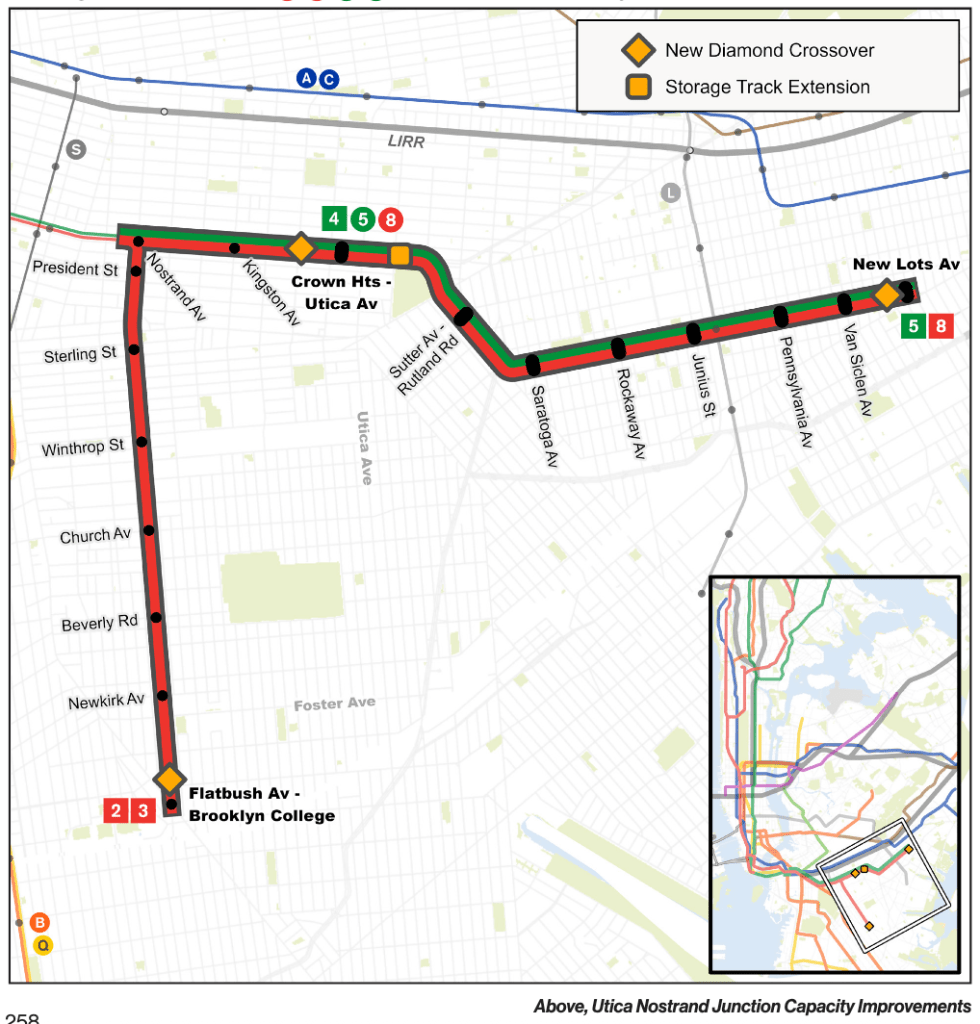
Now that all sounds great, but what are the downsides here? Well, there are a couple. The first is that Nostrand Ave (the station currently on the 3, not the Line served by the 2/5) and Kingston Ave users will likely see a decrease in service. These are middle of the pack usage stations, so this lowering of service will not be ideal, however this will hopefully be somewhat mitigated by having a more reliable service, and being able to run more trains on 7th Ave in general. Note that riders at Utica Ave and further east should see an increase in service and a train that will run express on Eastern Pkwy on weekdays, and the combined ridership of these 7 stations (not counting Utica for this comparison) is far higher than the two stations losing some service. (Outside of Utica, all the 3 stations east of Franklin Ave see similar levels of ridership). All ridership statistics from 2023 data provided by the MTA.
The other main downside is that there will need to be a significant suspension of service while these crossovers are being created. I have not found any comments from the MTA about this, however I can speculate on what service could look like during this suspension. My guess is that the 2 and 3 would take on their new routes, going to Franklin Ave on the local, then turning down the Nostrand Ave line. The 8 won’t exist yet, as it will be dangerous to run trains on the Eastern Pkwy line between Franklin and Utica. The local stations along this line won’t be served at all, and will have free shuttle busses running down Eastern Pkwy between Franklin and Utica. The 4/5 trains will have to end at Atlantic Ave – Barclay’s Center. While I wish I could end them at Franklin, the express tracks have no infrastructure (like switches) to turn around trains anywhere near Franklin. The nearest ones are at Utica, which would interfear with construction, or between Atlantic Ave and Nevins St, which is what I have them using. On a slight positive, Atlantic Ave has a center platform for the 4/5 so at least riders won’t need to play a game for which platform the train will leave from. Riders going to/coming from the 2/3 going to/from Nostrand will have a cross platform transfer at Nevins St.
But what about riders beyond Utica Ave? After all, I ended the shuttle busses here, so what will their service look like. My guess is that they will have a shuttle train running between Utica and New Lots. These riders will be able to transfer to the L at Junius St / Livonia Ave (this plan assumes that the in station transfer exists, which to my understanding is being worked on currently. Alternatively you can just make it free like the Rockaway Shuttle).
Now this service pattern definitely sucks. Its a combination of the Rockaway shutdown we just finished and the 63 St tunnel shutdown from a couple years ago, neither of which were great. However, the one saving grace here is that I do not believe this construction will be super long. It should have a time scale comparable to both of those projects – around 4-6 months. The provisions for this crossover already exists, and a full shutdown like this will allow work on it to be quick. I’m not trying to downplay the pain that will be felt for New Lots and Eastern Pkwy riders, but I hope that the amount of gain that this project could see will justify the pain here.
The last con I will mention is that Nostrand riders no longer have a one seat ride to Eastern Pkwy express / Lexington Services. This isn’t really that bad, since there is a cross platform transfer at both Franklin and Nevins, so switching trains here is very little hassle, which is why I’m not talking about it much.
Despite its real downsides, I am a firm supporter of this plan. It will make the A division’s operations much smoother and is a solid step to removing one of the worst merging conflicts in the entire system: the Nostrand Junction. It will also improve New Lots service, and be able to increase 7th Ave and Lexington Service as a whole. While there are of course a couple losers, the subway system as a whole is definitely winning from this plan.
F and M Swap
The F and M swap is a very simple proposal. Between the 6th Ave local line and the Queens Blvd Line (QBL), the F train currently takes the 63 St tunnel to get to QBL, while the M train takes the 53 St tunnel. The problem with this current setup is that there are a large number of merging conflicts: the F and M split/combine near 47-50 Sts, the E and M split/combine near 5th Ave – 53 St, the E/M split/combine near Queens Plaza, the M/R split/combine near Queens Plaza, and finally the E/F split/recombine near 36 St.
By swapping which tunnel the F and M take to QBL, we can lower the number of merging conflicts. Here are all of them in this modified service: the F/M split/combine near 47-50 Sts, the E/F split/recombine near 5th Ave – 53 St, and the R/M split/combine near 36 St. That is it! We take out two merging conflicts in this plan, practically for free! Why hasn’t this been done years ago?
Well, there are a couple reasons. The first reason is that the M has less capacity than the F train as it runs 8 car trains less frequently. This is only really half true though, as F trains are usually much fuller as it carries much of the QBL ridership, as riders east of Roosevelt Ave either will transfer to the E/F or will start on it, thus the locals M/R are mostly QBL riders west of Roosevelt Ave – the least used stations on QBL. This means that these M trains are not running anywhere near capacity, so it will be able to handle riders at stations currently. The Joint Transit Association has some more in depth math about it in their video supporting the swap in 2023, which you can check out here:
The other downside to this is related to weekend service. How will the 63 St tunnel be served if the M train doesn’t run to QBL on weekends? The current answer to this is that the F will return to the 63 St tunnel when the M is not running. This is not ideal in my opinion, and will probably end up being a source of confusion. However, with most people navigating with apps these days, I am probably worrying more than necessary here. But if I’m not, there is always the option to reintroduce the V train.
The pros and cons here are much simpler here than on Nostrand. No construction to worry about. The only loss in 1 seat rides would be QBL express riders wanting to go to 63 St, where they can just transfer to the local train cross-platform at Roosevelt, and QBL local riders wanting 53 St services, who can transfer to them cross platform at Roosevelt or Queens Plaza. These cross platform transfers are so easy to do that I don’t lament the loss of any 1 seat rides that are replaced by them.
So if it comes down to make the system slightly more confusing but better ran, I think that’s an easy trade to take every time.
Conclusion
The MTA is doing the impossible: doing small improvements to make the system better. The MTA at times seems to be hyper focused on big projects to vastly improve the system. SAS phase 2, the IBX, and Penn Access have all been talked about for years, but it will be many more years before we actually see them come to fruition. Smaller changes like these help fill in the gaps to make improvements to the system that we can see, while these bigger projects get worked on. With the F and M swap supposidly coming by the end of the year, and the Nostrand Junction redesign coming in the next capital plan, these small improvements are realistic improvements that I can get excited for soon, not in the 2030s. And for a system that can be so slow to change, it makes me feel more optimistic towards the future of the subway.
 David Rosenstein's Blog
Leave a comment